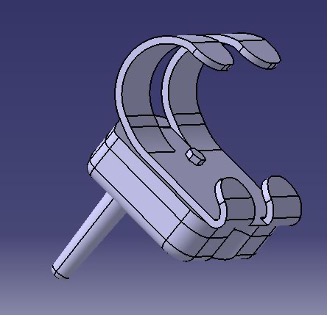
About the Project
Motivation: The increasing demand for knee replacement surgeries due to degenerative diseases has necessitated the design of lighter, more durable prosthetic knee joints. This project aims to develop and analyze a prosthetic knee joint capable of sustaining high loads while maintaining biomechanical compatibility and cost-efficiency.
Objective: The project seeks to design and analyze a flexible prosthetic knee joint using materials with high longevity, low maintenance, and excellent biomechanical compatibility. It focuses on von-Mises stress, total deformation, and strain distribution under varying loads.
Technical Overview
Design and Analysis
The project utilized the following tools and methodologies:
- CAD Modeling: CATIA V5 was used for creating the 3D model of the knee prosthesis.
- Finite Element Analysis (FEA): ANSYS 14.5 was employed to simulate stress, deformation, and strain distributions under static conditions.
- Material Selection: Analysis of biomaterials such as TI-6AL-4V, TI-6AL-7NB, and ABS for their suitability in prosthetic applications.
- Boundary Conditions: Load simulations considered static and dynamic forces during walking and running activities.
Material Properties
The study evaluated various biomaterials:
- TI-6AL-4V: High strength, corrosion resistance, and biocompatibility.
- TI-6AL-7NB: Similar properties to TI-6AL-4V with enhanced mechanical performance.
- ABS: Lightweight and cost-effective for temporary implants.
- Stainless Steel 316L: Limited corrosion resistance but widely used for temporary orthopedic implants.
Results
- Stress Distribution: TI-6AL-7NB showed optimal stress distribution and resistance under high loads.
- Deformation: Total deformation was minimized using titanium alloys compared to ABS and stainless steel.
- Durability: Titanium alloys exhibited superior long-term durability and biocompatibility.
Challenges and Solutions
- Complex Geometry: Accurate modeling of the knee joint's anatomical structure using CATIA.
- Material Selection: Extensive testing of biomaterials to ensure biocompatibility and mechanical reliability.
- Load Analysis: Iterative simulations in ANSYS to refine load distribution and optimize geometry.
Technologies Used
- CAD Software: CATIA V5 for 3D modeling.
- FEA Software: ANSYS 14.5 for structural analysis.
- Materials: TI-6AL-4V, TI-6AL-7NB, Stainless Steel 316L, ABS.
Future Scope
- Advanced Materials: Exploration of next-generation biomaterials with improved fatigue resistance.
- Dynamic Analysis: Incorporating real-time gait data to refine stress and deformation simulations.
- AI Integration: Using machine learning to predict wear patterns and optimize designs further.